The Sunday they cancelled everything.
The Ten of Wands as intentions can describe devotion under pressure. It also asks whether carrying on leaves any room to be together.

By Sunday morning, there were eleven stops on the list. Pick up his mother's shopping. Return the hired carpet cleaner. Collect a parcel. Buy a hinge. Visit the friends they'd postponed twice already. Ruth watched Martin add petrol while their breakfast burned under the grill.
Their youngest had moved out that spring. Ruth had imagined the quiet house giving them more time together. Instead, Martin filled every available hour with jobs. When she suggested a walk, he looked wounded. Couldn't she see how much he was doing for them?
She could. She couldn't remember the last time they'd enjoyed any of it.
In the Rider-Waite-Smith Ten of Wands, a figure carries a bundle toward a settlement. The load blocks much of the view ahead and obscures the person's face. There is persistence in the picture, but little space for an easy encounter along the way.
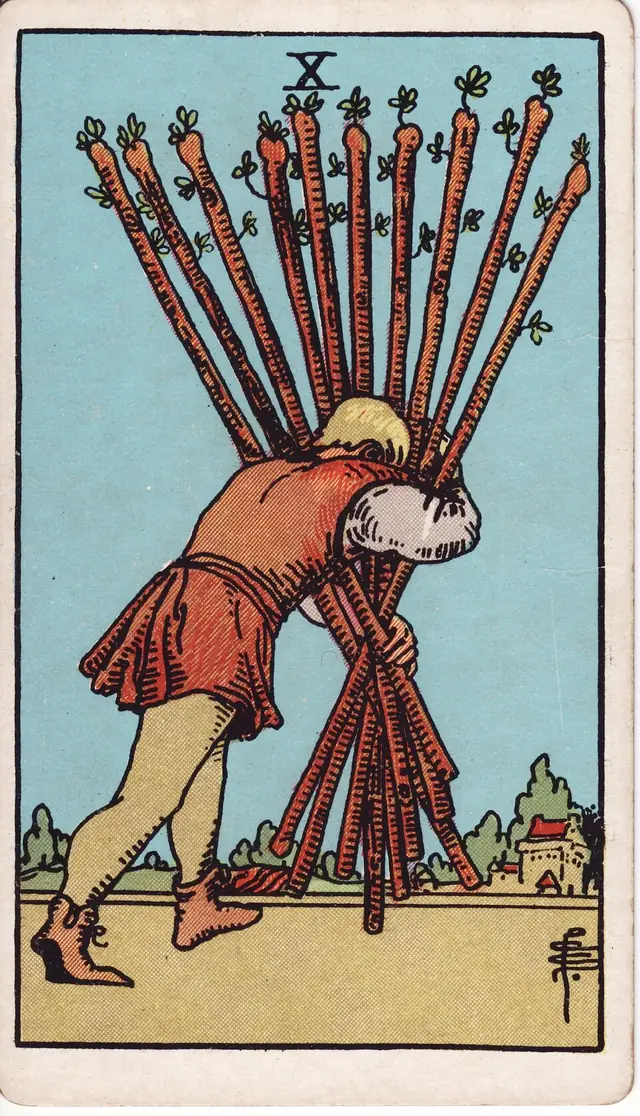
Ten of WandsThe destination remains visible while the carrier nearly disappears behind the load. The card can explore responsibility and overextension without assuming that enduring more will deepen a relationship.
As intentions, the upright Ten of Wands may suggest trying to fulfill commitments, keep a relationship going or reach the end of a demanding period. The wish to continue can coexist with very little emotional availability.
In early dating, that may mean interest without room to develop it. In a long partnership, duty can consume the time affection needs.
Martin did have real responsibilities. His mother needed help, and the house needed repairs. Ruth's loneliness didn't make those facts false. Nor did the facts make loneliness unreasonable. Reading this card usefully means giving both people a place, including the one whose time keeps becoming the flexible part of the arrangement.
Reversed, the Ten of Wands can suggest a wish to set something down. That may mean sharing work, admitting limits or stepping away from a responsibility. Sometimes it describes relief after practical changes. Sometimes someone reduces pressure by withdrawing from the relationship itself. The reversal alone can't tell you which burden will be released.
After separation, the load could be guilt, unfinished tasks or the effort of fragile contact. Carrying it wouldn't prove lasting romantic intentions. A card offers a way to explore the pressure; what someone says and does is needed to understand their actual choice.
Ruth asked Martin to sit down before they drove anywhere. She showed him the list and asked which jobs would have an ending. He named a few, then stopped. The parcel would lead to a return. The garden would always grow. He'd been trying to finish everything before they started enjoying their new life.
They kept his mother's shopping. Martin arranged to share future trips with his brother. They cancelled the visit with an honest explanation and left the hinge alone. Ruth didn't become the manager of his lighter schedule. They each chose what they could take responsibility for, including what they would stop promising.
In the afternoon they walked to the reservoir. Martin began describing how to fix the gate at its entrance, then laughed at himself. They sat on the low wall long enough for the conversation to move somewhere else.
At home, the gate still needed a hinge. For once, that wasn't what the day had been for.