When they stopped keeping score.
The Two of Cups as feelings points toward an exchange. After conflict, affection can reopen contact while practical repair still needs its own conversation.

Sana brought the board game out after dinner because it used to make them laugh. Half an hour later, she and Rob were arguing over a rule neither cared about. He said she always needed to win.
She said he only noticed rules when he was losing. They both knew they weren't talking about the game.
The week before, he'd agreed to host his family without asking her. She'd made a pointed joke about it in front of everyone. Since then, their evenings had become polite competitions: who had cooked, who had cleared, who had apologized first last time.
Together for twelve years, they could read each other's expression and still miss the person making it.
The Two of Cups as feelings directs attention to the exchange beneath that accounting. In the Rider-Waite-Smith image, two figures face one another, each holding a cup. Neither carries both. An opening can be offered, but one person cannot manufacture the other side of a meeting.
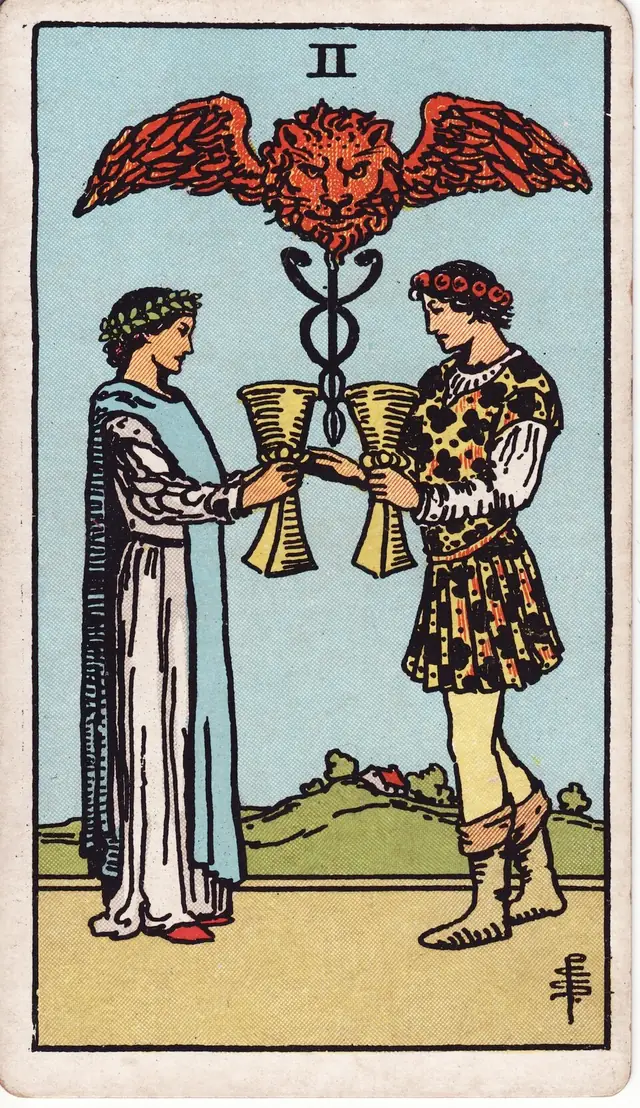
Two of CupsEach figure brings a cup. Mutual recognition can support attraction or repair, while leaving questions of commitment and practical arrangements to be addressed in their own right.
Upright, this card can suggest affection, attraction and the pleasure of feeling understood. In early dating, it may describe promising mutual interest without establishing exclusivity. In a long relationship, it can bring the couple back into view beneath the running of a household.
After conflict, the invitation may be to approach each other as people, each with a separate experience.
Rob put down his game piece and said he missed being on Sana's side. She nearly replied that he had a strange way of showing it.
Instead, she admitted that she'd made the joke because she'd felt taken for granted, and that she knew it had embarrassed him. He said he'd treated their home as though her availability came with it.
A warm exchange leaves work to do
A tender conversation could matter without resolving the pattern. The Two of Cups isn't a guarantee that everything is repaired or that both people want the same future. It describes a possible quality of contact. Their own words, choices and follow-through would have to show whether that contact could support change.
Reversed, the card can reflect a missed or uneven exchange. One person may offer reassurance when the other needs an honest answer. Feelings may not be mutual. Or harmony may depend on someone repeatedly agreeing to things they don't want, leaving only one fully present person in a relationship that looks peaceful.
Sana recognized that last possibility. She'd agreed to previous visits while expecting Rob to notice the cost. He'd taken the agreement as enthusiasm. She could take responsibility for saying what she meant without accepting responsibility for every plan he made. They decided that invitations involving both of them required both of them to agree.
The next weekend, his sister asked about staying. Rob checked with Sana before replying. Sana said one night worked and two didn't. Nobody produced a tally of the last visit. It was a small negotiation, less emotional than the night of the board game and more useful than a promise never to argue again.
They left the game unfinished for a few days. When they returned to it, Rob still misread the same rule. Sana still wanted to win. This time, those were the only things they were competing over.