The space between two names.
The High Priestess as feelings can hold quiet attraction and inward attention, while leaving another person the right to name their own experience.

At the bookshop, Tess knew which customer would ask for poetry before he reached the counter. Gabriel always stopped at the window display, read one cover and came in with a question about a different book. Over time, the questions became conversations. Then they became Thursday walks after the shop closed.
Her colleague called him her boyfriend once. Tess corrected her quickly, then spent the walk wondering whether Gabriel had heard. He carried the book she'd chosen and asked about her sister. They were intimate in details and undefined in every other way.
Tess trusted the feeling between them. She also knew how much she'd contributed to it privately. She'd imagined introducing him to friends, pictured the first dinner at her flat, and rehearsed an answer to a question he hadn't asked.
The quiet had begun to contain a whole relationship for which only one person had supplied the words.
The High Priestess as feelings can suggest private attraction, careful observation or emotion held inwardly. In the Rider-Waite-Smith image, she sits between two pillars with a veil behind her. Access and boundaries are part of the scene. Something may be meaningful without being available to another person on demand.
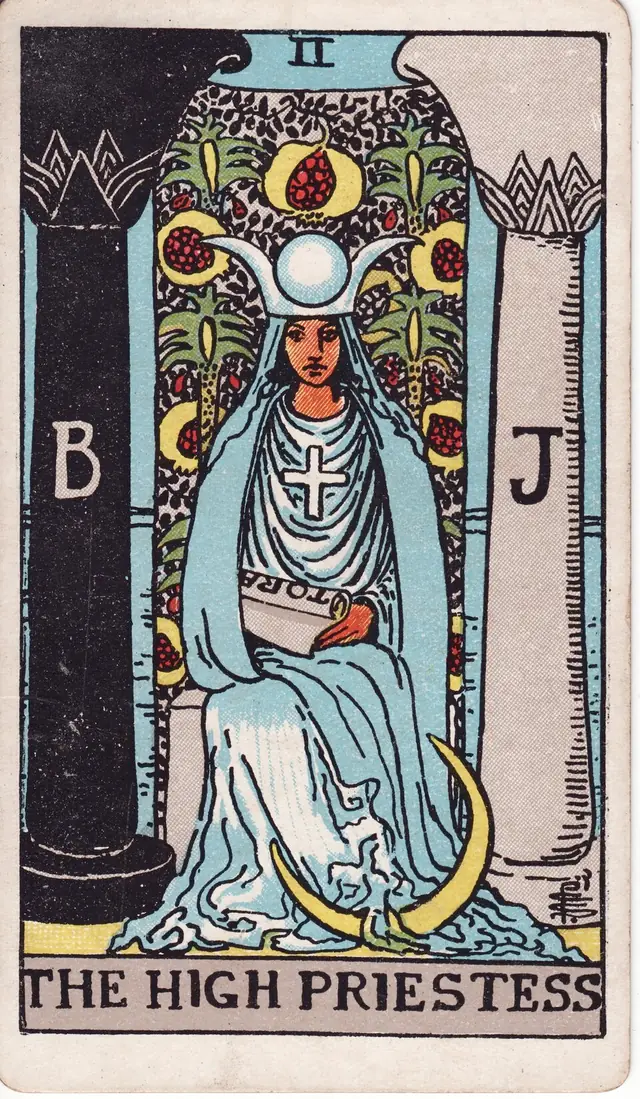
High PriestessThe pillars and veil suggest inwardness and privacy. A feelings reading can respect what hasn't been disclosed while asking what needs to become shared understanding.
Upright, the card may describe someone who observes before speaking, values an inner bond or hesitates to change a relationship by naming it. It may also direct attention to your own intuitive response. Do you feel at ease? Do reassuring words leave you tense?
Those impressions are useful when connected to specific moments, rather than treated as access to another person's thoughts.
Tess remembered that Gabriel always made time for the walks. She also remembered that he called them friends. The tenderness was real as an experience. The romantic meaning was still hers to ask about. A card couldn't turn her certainty into his consent or make privacy a puzzle she was entitled to solve.
Reversed, the High Priestess can suggest losing touch with your own response, withholding something needed for honest participation or ignoring discomfort to preserve an appealing mystery. In a long relationship, it may expose the cost of expecting a partner to know without being told. Naming a need gives someone a way to meet it.
On Thursday, Tess suggested sitting in the square rather than walking their usual route. She said she'd started to want a date and asked whether he would like that too. The question sounded less elegant aloud than it had in rehearsal. She was glad she'd said it in her own voice.
Gabriel took time to answer. He cared about her and loved the walks, he said, but he wanted friendship. Tess didn't search his hesitation for a truer reply. She told him she needed a few Thursdays to herself. He said he understood.
Neither tried to make her disappointment disappear by calling their friendship exactly the same.
A month later, she invited him to a book discussion with several friends. Going alone with him still felt too close. A group felt possible. She chose that smaller opening because she wanted it, rather than because it might eventually become a date.
The affection had a name now. She could decide how much room to give it.