She noticed the part of the story that hurt.
The Queen of Cups as feelings suggests tenderness and attention. Care becomes more trustworthy when both people can say what they need.

Milo told the story as a joke: the spilled coffee, the wrong meeting room, the manager who'd called him by somebody else's name. Farah laughed, then asked whether the meeting had been disappointing. He stopped stirring his drink. It had.
He'd wanted to be considered for a new project and hadn't known how much until it went to someone else.
They'd only been seeing each other for a few weeks. Her question stayed with him longer than anything romantic she'd said. She'd heard the disappointment he was trying to make entertaining. For once, he hadn't needed to make a convincing case for being upset.
That is the particular tenderness the Queen of Cups can bring to a feelings reading. In the Rider-Waite-Smith image, the queen studies an elaborate cup beside the water. Her attention gives the cup importance without exposing its contents. The image can speak to care for another person's inner life, including what remains delicate or private.
Upright, the Queen of Cups as feelings may suggest affection, receptivity and a wish to understand. Someone may feel moved by your vulnerability or unusually open around you. This can deepen romantic attraction. It can also belong to friendship; the quality of care doesn't establish a relationship status on its own.
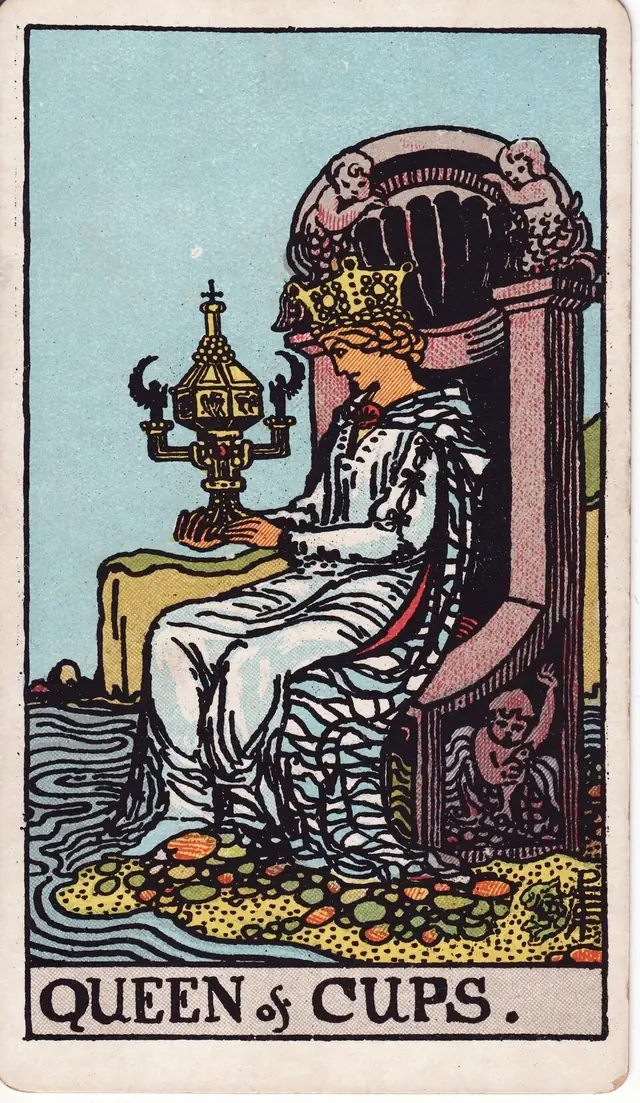
Queen of CupsThe carefully held cup suggests emotional receptivity. The useful question is whether being understood leads to a response that fits, with room for both people's needs.
The Queen's emphasis is attunement: noticing, listening and allowing another person's experience to register. The King of Cups places more emphasis on remaining steady with emotion. Anyone can express either quality. Neither card makes one person responsible for anticipating everything the other hasn't said.
Milo soon began bringing Farah every difficult workday. She was good at listening, and he felt close to her afterward. He didn't notice that she was postponing her own stories until there was time. When she mentioned an argument with her brother, he compared it to a problem with his manager and kept going.
A week later, Farah cancelled dinner. She said she was tired and wanted an evening alone. Milo heard rejection. Farah had been expecting him to notice the imbalance without naming it. Their mutual sensitivity had produced several accurate observations and one conversation they'd both avoided.
Reversed, the Queen can suggest emotional over-absorption, blurred boundaries or care offered past the point of exhaustion. It can also show limited receptivity: someone welcomes only the feelings that fit their preferred story. Real tenderness may be present while the exchange becomes unsustainable.
When they met again, Farah said she liked being trusted and needed to be asked about her own day. She also wanted some dates that weren't organized around distress. Milo resisted the urge to explain how grateful he was. He asked about her brother, then listened without looking for the matching event in his life.
They tried a useful question: did the other person want listening, help thinking, or a break from the subject? Sometimes Farah chose a break. Sometimes Milo did. The limits made their attention less effortless and more honest.
At the next cafe visit, he began another work story, caught himself, and asked whether she had room for it. She said ten minutes, then she wanted to tell him something funny. They talked about the meeting.
Then they laughed about her terrible attempt at a pottery class. His worries hadn't lost their welcome. They had stopped taking every available seat.